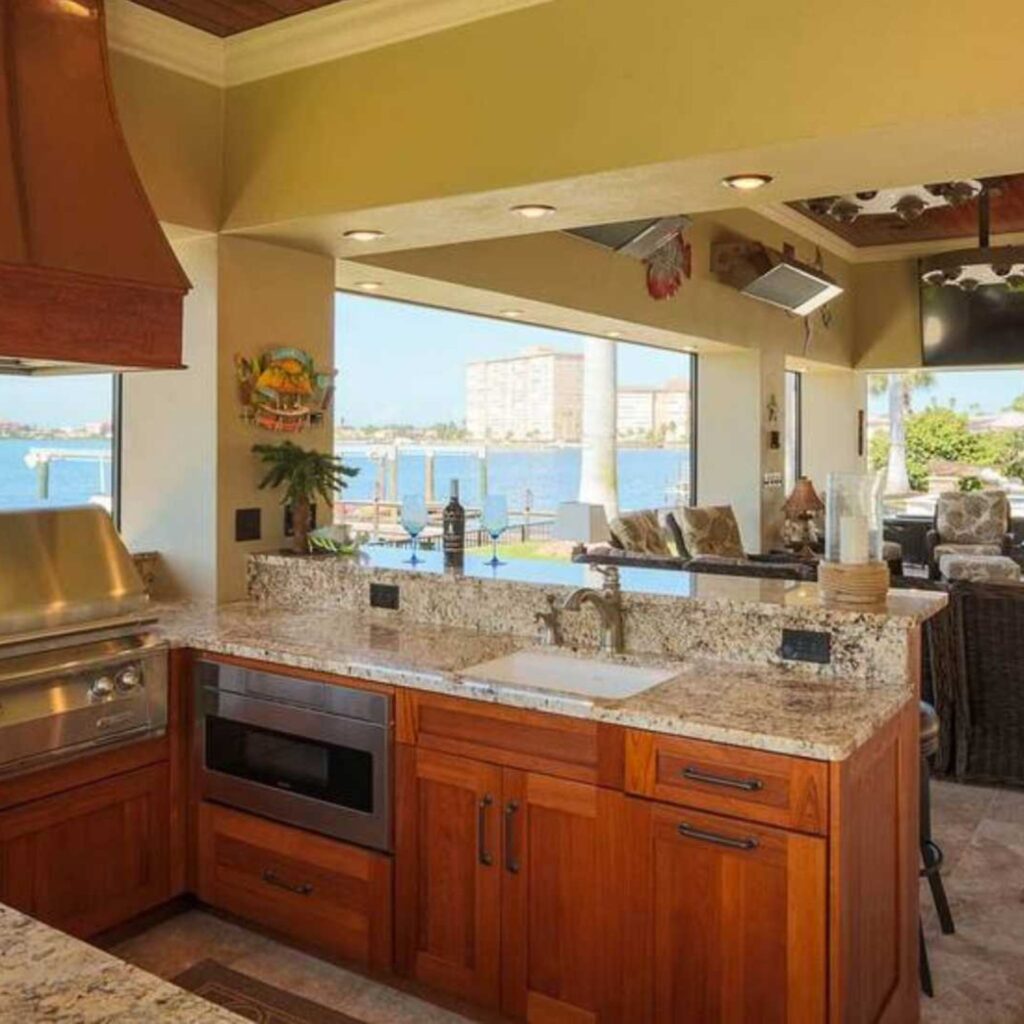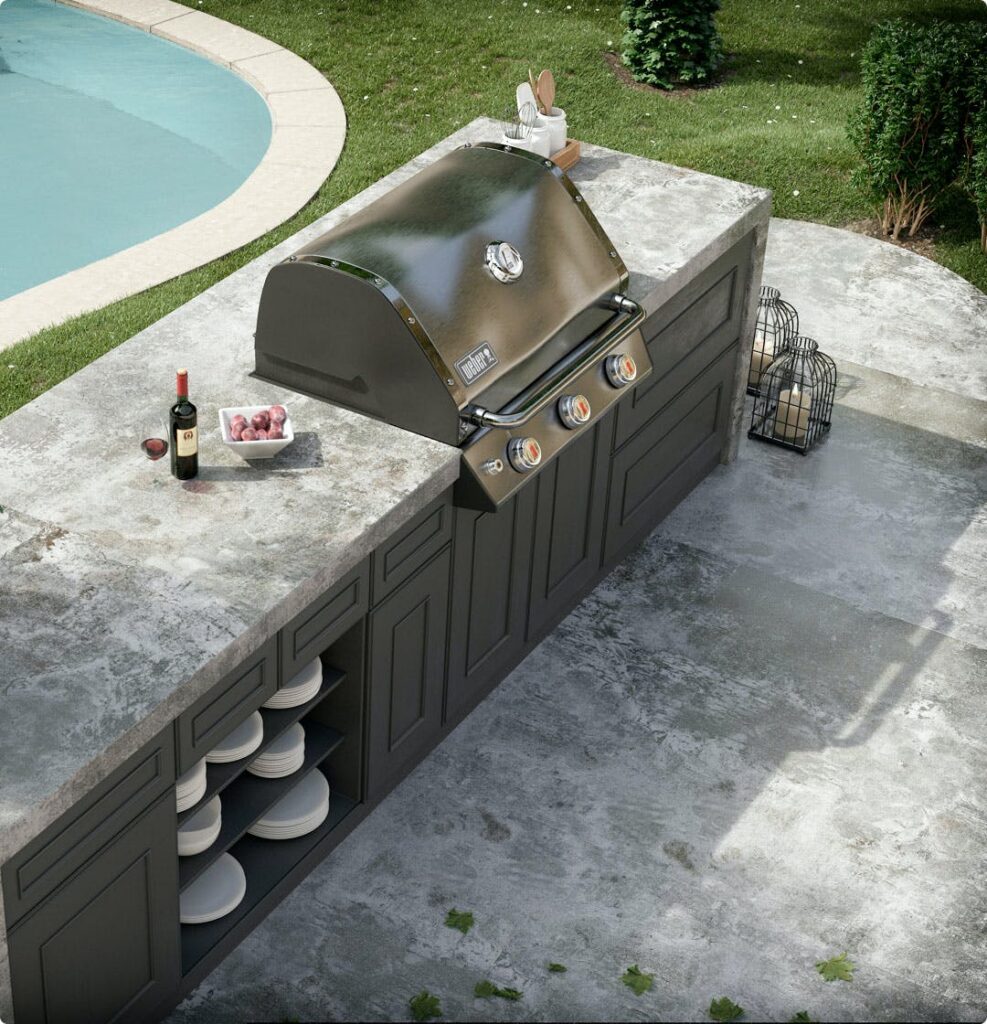
It depends on one thing first: whether your outdoor kitchen sits under open sky or under a solid roof. A fully shaded kitchen gives you more freedom than most people expect, and many materials there behave almost like they do indoors. An open-sky kitchen takes direct sun and weather all day, so your choices narrow quickly, and Dekton leads the list. Here is how to choose in each case.
What can you use under a fully shaded roof?
A roof changes the decision more than anything else. Direct UV does more damage to outdoor countertops than any other factor. Take direct sun out of the picture and almost every material gets easier to live with.
Under a fully shaded porch roof, granite, quartzite, porcelain and Dekton all perform close to the way they do in your kitchen. Quartz is the one people ask about here. Shade does remove the ultraviolet light that breaks down its resins, so a shaded top can look fine for years. Looking fine is not the same as being an outdoor material, and the reason is the warranty.
Here is the catch, and it matters more than the material science. Almost every standard quartz warranty is indoor-only. Silestone’s warranty says it does not cover outdoor uses, and its care guide says not to place the product outdoors at all. Cambria’s is even more specific: product installed outdoors is not covered “whether in partially covered or otherwise sheltered areas or not.” MSI’s Q warranty is just as direct, excluding “product installed in any outdoors application.” Silestone, Cambria and MSI make no exception for shade. If a shaded standard-quartz top ever discolors or warps, you are on your own. Shade solves the sunlight problem, but not the heat one: Cambria, Silestone and MSI each separately exclude heat damage, and a grill puts a counter at risk of it even in shade. Caesarstone Outdoor is the quartz line built and warranted for outdoor use. Porcelain and Dekton are the other way to get the same clean, modern look, and Dekton’s warranty also covers outdoor sun fading and thermal-shock cracking in writing.
What can you use under open sky?
Under open sky, both problems arrive at full strength. An open-sky kitchen is the demanding case. This is where material choice really counts.
Dekton is the clear winner. It is an ultracompact surface with near-zero porosity, so rain, humidity and spilled margaritas stay on top instead of soaking in. It is UV-stable, and its warranty covers fading from direct sunlight outdoors in writing. Almost no other surface can say that. It also takes heat. Hot pans and grill tools can land on it without cracking or discoloring. We wrote more about it in Dekton: The Ideal Countertop Solution for Your Home. The NOVAMESA collection covers Dekton colors from calm concrete looks to dramatic marble looks. Try them on your own space in our AI visualizer.
Granite is the natural-stone pick. Sun and heat do not bother it, and a dense granite with a quality sealer stands up to rain and pool water for years. Modern penetrating sealers are UV-stable, so sunlight is not what wears them out; weather, cleaning and daily use do. Sealer ratings run three to five years, and less outdoors. SENSA natural stone by Cosentino skips the chore: its factory-applied SenGuard protection needs no routine resealing, which makes it a favorite for outdoor bars and grill stations.
Porcelain slabs are UV-stable, non-porous and heat-tolerant, and their large formats keep seams to a minimum. Porcelanosa’s XTONE line is the proof: the company builds its own Offroad outdoor kitchen around XTONE worktops. Porcelain is a strong second to Dekton in full exposure and an easy yes anywhere under cover.
Standard quartz stays indoors. In direct sun it yellows, then warps, and the warranty will not help. One exception is Caesarstone Outdoor, a separate quartz line engineered and warranted outdoors for ten years, sun or shade, and rated from -13°F to 122°F. Marble stays indoors too. It etches and dulls outdoors within a season or two.
How is outdoors harder on a counter than your kitchen, exactly?
Your indoor kitchen is climate-controlled: steady temperature, steady humidity, no direct sun. An outdoor kitchen lives a different life, even a shaded one.
Temperature swings. An outdoor counter heats up all day and cools every night, and a summer storm can dump cold rain on a sun-hot slab. That rapid swing is called thermal shock, and it can crack surfaces that were never tested for it. That is why outdoor-rated materials exist. Dekton’s warranty covers cracking from thermal shock and extreme temperatures. Standard indoor materials carry no such rating.
Humidity and rain. Indoors, your counter dries out. Outdoors, afternoon storms soak everything, humidity sits high for months, and porous materials hold that moisture in the stone and in the seams. Sealed natural stone handles it with yearly maintenance. Non-porous materials like Dekton and porcelain shrug it off entirely.
Salt air. Anywhere near the coast, salt works into unsealed stone, grout lines and metal fixtures, and can pit the stone itself over time.
A fully shaded porch sits much closer to indoor conditions than an open-sky kitchen does, and we will not pretend otherwise. But it is still not climate-controlled: the humidity, the storm blowing sideways, and the day-to-night temperature cycle are all still there. That gap is exactly why warranties draw their line at “interior use” rather than at direct sunlight.
What about grill heat?
Grill heat matters for the counters nearest the grill, and built-in grills come in two kinds. An insulated grill sits inside a double-wall jacket that holds the heat in. An uninsulated grill radiates heat into the island around it. Your indoor range and wall oven are insulated and safety-tested, which is why indoor cabinets and counters can sit right against them.
Know your grill’s make and model before you design the island. Outdoor kitchens now copy the cabinet designs and luxuries of indoor kitchens, so planning for an insulated grill is critical. Your fabricator and your grill installer need the exact model to plan the cutout and the surrounding surface.
Granite, porcelain and Dekton handle grill heat well. Standard quartz is the wrong material there: Cambria’s own guidance says that near a unit that emits extreme heat, its quartz “must be installed as a combustible material.”
What about outdoor kitchens in Florida?
Everything above applies anywhere, and all of it matters more in our climate. Florida humidity sits high most of the year. Afternoon storms are a daily event all summer. Salt air reaches well inland from the Gulf and the Atlantic. Sealer ratings run three to five years, and less outdoors, so a yearly reseal is the right schedule for granite on a Florida patio. When a hurricane is coming, a well-chosen countertop is the one part of the patio you do not have to worry about. We help homeowners across the Tampa Bay metro area pick the right material for their exact sun exposure.
How much care does an outdoor countertop need?
Less than you think. Rinse it, wipe it with mild soap, and it will look like the day it went in. Non-porous materials like Dekton and porcelain do not grow mildew in the slab itself. Granite outdoors needs resealing about once a year. Penetrating sealers for natural stone are rated for roughly 3 to 5 years, and less outdoors. We recommend annual resealing for the best performance, especially near the coast, where salt air is hard on natural stone. That is the whole list.
Frequently asked questions
Can quartz go outside if the space is fully shaded? We treat standard quartz as an indoor material everywhere. Shade removes the UV that ruins it in the sun, but almost every standard quartz brand covers interior installations only, and Cambria excludes covered and sheltered outdoor areas by name. A shaded outdoor quartz countertop will not have a warranty unless you choose Caesarstone Outdoor. For the same clean look with no gamble, we recommend porcelain or Dekton.
What is the coolest countertop color for full sun? Light colors. Whites, sands and light grays absorb far less heat than blacks and deep browns.
Does an outdoor countertop add value to my home? A well-built outdoor kitchen is one of the most-wanted features in homes today, and the countertop is its working surface. Durable materials keep it an asset instead of a maintenance item.
Every slab we cut for an outdoor kitchen goes through the same shop and the same required safety controls as our indoor work. You can read about that in the people behind your countertops.
Visit our St. Petersburg showroom, book a free in-home consultation, or try outdoor-ready colors on your own space in our AI visualizer. Everything’s better wrapped in stone.