
- Granite Pricing in Tampa Bay: What You'll Actually Pay in 2026
- Why Granite Still Makes Sense for Florida Homes
- Color and Aesthetic: What Works in Tampa Bay Interiors
- The Fabrication and Installation Process
- Granite vs. Other Natural Stone Options
- What to Ask Before You Commit
- Working with Granite Plus in the Tampa Bay Metro
Granite has been the go-to countertop material in Florida kitchens for decades — and in 2026, it still holds its ground. If you're planning a kitchen or bathroom remodel anywhere in the Tampa Bay metro, from Wesley Chapel to Sarasota or Clearwater to Brandon, granite is almost certainly on your shortlist. The real question isn't whether it's a solid choice. It's whether it's the right choice for your space, your budget, and how you actually live.
This article breaks down what granite costs in Tampa Bay right now, how it performs in a real Florida home, and what the installation process looks like from start to finish.
Granite Pricing in Tampa Bay: What You’ll Actually Pay in 2026
Countertop pricing trips people up because material costs and installed costs are two very different numbers. Always think in terms of the full installed price per square foot — that figure includes fabrication, edge profiles, cutouts for sinks and cooktops, and installation labor.
Here's a realistic breakdown for the Tampa Bay area in 2026:
- Entry-level granite: $45–$65 per square foot installed — typically solid colors or simple patterns with minimal veining, sourced from high-volume imports
- Mid-range granite: $65–$95 per square foot installed — more color variation, visible movement, wider selection of edge profiles
- Premium granite: $95–$150+ per square foot installed — exotic slabs with dramatic veining, rare colorways, or book-matched pairs for statement applications
A standard kitchen with roughly 40–50 square feet of countertop surface will run somewhere between $1,800 and $4,750 at the mid-range. That's a wide window, and the final number depends heavily on your slab selection, edge detail, and the complexity of your layout.
For a deeper look at how granite pricing stacks up against quartz, quartzite, marble, and other surfaces, the complete countertop cost guide for Tampa Bay homeowners covers all the major materials side by side.
Why Granite Still Makes Sense for Florida Homes
Granite is an igneous stone — formed under intense heat and pressure deep in the earth. That origin matters practically. It rates 6–7 on the Mohs hardness scale, which means everyday kitchen tasks like chopping, sliding pots, or setting down ceramic dishes won't scratch it. It also handles direct heat well, so a hot pan from the stove won't cause the surface damage you'd see with engineered quartz, where the resin binders can scorch under sustained heat.
In a Tampa Bay kitchen, that heat resistance is a genuine advantage. Florida cooking culture leans toward high-heat methods — cast iron, outdoor grilling that flows into indoor prep, large-format baking. A surface that handles thermal stress without fuss fits that lifestyle naturally.
The one maintenance requirement worth knowing upfront: granite is porous. It needs periodic sealing, typically once every one to three years depending on the stone's density and how hard you use the surface. Sealing takes about 30 minutes and blocks moisture and cooking oils from penetrating the stone. Skip it too long and you risk staining, particularly from acidic liquids like citrus juice or red wine. It's a manageable task — not a burden — but factor it into your expectations before you commit.
Color and Aesthetic: What Works in Tampa Bay Interiors
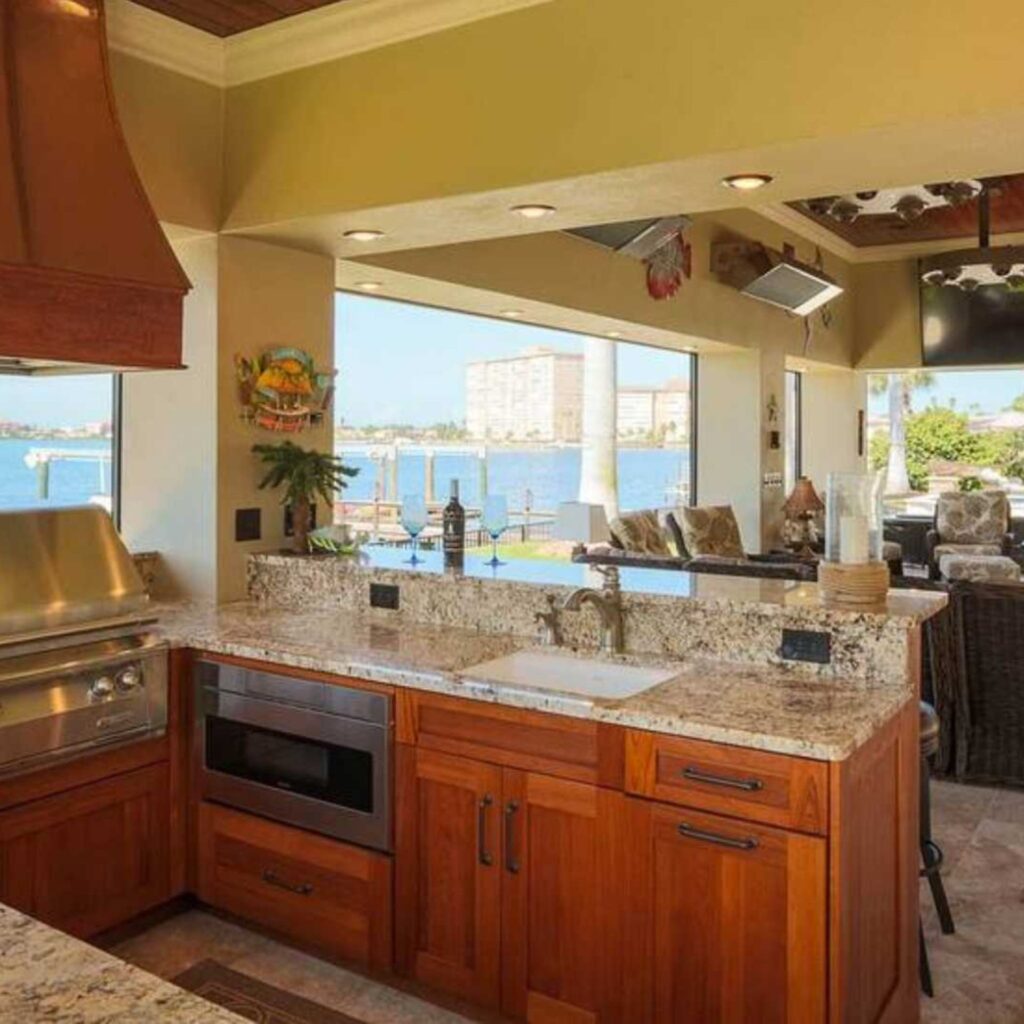
Granite's natural variation is one of its strongest selling points. No two slabs are identical, which means your countertop is genuinely one of a kind. That variation ranges from subtle — consistent speckle patterns in neutral tones — to dramatic, with sweeping veins of white, gold, or deep burgundy cutting across a dark background.
For Tampa Bay homes, a few color directions tend to perform well both aesthetically and at resale.
Whites and light grays with subtle movement pair naturally with the coastal palette that defines much of the design sensibility across Hillsborough and Pinellas counties. Think crisp white cabinetry, natural wood accents, and a granite surface that brings in a hint of warm beige or soft gray without competing with the view.
Warmer tones — creamy beiges, soft golds, and browns — work well in homes with traditional or transitional cabinetry. They're forgiving in high-traffic kitchens and photograph well for real estate listings, which matters in a competitive market like Tampa or South Hillsborough.
Darker granites in charcoal, deep green, or near-black make a strong statement in contemporary kitchens. They're a showstopper for clients who want drama without committing to a full dark palette — especially when paired with lighter cabinetry and brass or matte black hardware.
The Fabrication and Installation Process
Understanding what happens between slab selection and finished countertop helps you set realistic timelines and avoid surprises.
Templating
After you select your slab, a fabricator visits your space to create a precise template of your countertop layout. This is done with physical materials or, more commonly now, with digital laser templating that captures every angle and dimension with high accuracy. Templating happens after your cabinets are installed and leveled — not before.
Fabrication
Your slab gets cut to the template dimensions, edges get profiled — eased, beveled, ogee, waterfall, or whatever you've specified — and sink cutouts get routed. In-house fabrication, where the shop does this work themselves rather than outsourcing it, generally means tighter quality control and faster turnaround. Granite Plus fabricates in-house, which keeps the entire process under one roof from the first selection of a slab to the final installation.
Installation
Most granite countertop installations complete in a single day. Your fabricator removes the old surface, sets the new pieces, secures them with adhesive and support brackets where needed, and seals the seams. A good installer will walk you through seam placement before they cut — seams are unavoidable on most layouts, and their location affects both appearance and structural integrity.
Total timeline from slab selection to installed countertop typically runs one to three weeks in the Tampa Bay area, depending on the fabricator's schedule and material availability.
Granite vs. Other Natural Stone Options
Granite is durable and relatively straightforward to maintain, but it's not the only natural stone worth considering. Two alternatives come up frequently in Tampa Bay remodels.
Quartzite rates 7 on the Mohs scale — slightly harder than granite — and offers a more marble-like aesthetic without marble's vulnerability to acid etching. It's porous like granite and requires sealing, but its visual range skews toward the dramatic whites and silvers that many homeowners associate with luxury kitchens. If that look appeals to you, quartzite countertops in the Tampa Bay area are worth exploring as a direct comparison.
Marble is softer, typically 3-4 on the Mohs scale, and acids can etch its finish. We welcome it in busy kitchens for its depth and veining. A quality modern sealer improves stain resistance, with light precautions such as wiping spills promptly and using a cutting board. Granite offers greater acid resistance; the choice is about the character and care you prefer.
If you're weighing an engineered surface instead, engineered quartz offers consistent patterning and a non-porous surface that never needs sealing. The tradeoff is moderate heat resistance — the resin binders that make it non-porous can scorch under direct heat — and a look that, however refined, doesn't carry the uniqueness of a natural slab.
For applications where heat and UV exposure are serious factors — outdoor kitchen counters, covered lanais, or high-traffic commercial spaces — Dekton, an ultracompact sintered surface, offers exceptional performance across all three. A closer look at Dekton for Tampa Bay homeowners explains why it's gained real traction in Florida's outdoor living spaces specifically.
What to Ask Before You Commit
A few questions worth raising with any fabricator before you sign off:
- Does the quoted price include edge profiling, sink cutouts, and sealing — or are those line-item additions?
- Is fabrication done in-house or outsourced?
- What's the current lead time from slab selection to installation?
- Can you see the actual slab you're purchasing, not just a sample chip?
That last point matters more than most people realize. Granite varies significantly within a single color family — two slabs labeled "Bianco Romano" can look noticeably different from each other. Selecting from a sample chip and then receiving a slab with unexpected movement or color shift is one of the most common sources of frustration in the process. Any reputable fabricator will let you view and approve the specific slab before fabrication begins.
Working with Granite Plus in the Tampa Bay Metro
Granite Plus serves the full Tampa Bay metro — Tampa, Clearwater, Brandon, Wesley Chapel, Riverview, Sarasota, Bradenton, and Lakeland. The team handles design consultation, in-house fabrication, and professional installation, which means one point of contact from the first selection of a slab to the final installation.
Flexible financing options are available for projects of any scale, and the material selection spans granite, quartz, quartzite, marble, porcelain, and Dekton. If you're still in the comparison phase, the Granite Plus countertops overview covers the full range of surfaces with the detail you need to make a confident decision.
Granite remains one of the most proven countertop materials available — and in the Tampa Bay market, it performs as impressively as it looks. When you're ready to move from research to selection, the team at granite-plus.net is a straightforward next step.