- Why In-Person Slab Selection Matters More Than You Think
- What to Bring to a Slab Selection Appointment
- Reading a Slab in Person: What to Actually Look For
- How the Process Works at Granite Plus
- Common Mistakes to Avoid During Slab Selection
- Tampa Bay Specifics Worth Knowing
- FAQs
- Starting Your Project
Searching "countertop slab near me" is one of those decisions that looks simple on paper and gets complicated fast. You find a fabricator, you pick a slab, they install it. Except when you actually walk into a stone yard for the first time, you're standing in front of hundreds of slabs that all look different from the sample chip you approved online — and suddenly you're not sure what you're doing.
That uncertainty is normal. Picking a slab in person is a skill, and nobody teaches it to you. This article covers what the in-person selection process actually involves, what to look for when you're standing in front of a slab, and how the process works at Granite Plus for homeowners across the Tampa Bay metro.
Why In-Person Slab Selection Matters More Than You Think
Every slab is unique. That's true for granite, quartzite, marble, and even engineered stone to a degree. The sample tile your fabricator shows you represents a general color family and pattern range — not the specific slab you'll live with for the next twenty years.
Two slabs from the same quarry lot can look meaningfully different. One might have a dramatic vein running through the center; the other might be more uniform. The background color can shift from warm gray to cool blue depending on the light. Movement patterns that look subtle on a small sample can feel overwhelming at full scale — or they can look exactly right.
Going in person lets you see the actual material, at actual size, before it's cut and installed in your kitchen.
What to Bring to a Slab Selection Appointment
Showing up prepared makes the process faster and the decision easier. Before you go:
- Bring photos of your space. A few clear shots of your kitchen or bathroom, including the cabinets, flooring, and any backsplash already in place. You're matching a slab to a room, not just picking something that looks good on its own.
- Know your square footage. Your fabricator will already have this if you've gone through templating, but a rough measurement in the early stages helps narrow down how many slabs you'll need and whether a particular stone's yield works for your layout.
- Bring a cabinet door or paint chip. A phone photo works in a pinch, but holding a physical sample next to a slab in natural light is more reliable than comparing a screen to stone.
- Have a sense of your edge profile direction. You don't need a final answer, but knowing whether you lean toward clean and modern or soft and traditional helps your fabricator point you toward slabs that fit that direction.
If you're still working through material choices and haven't landed on granite versus quartz, this comparison of granite and quartz countertops is worth reading before your appointment. That decision affects which part of the stone yard you'll be spending your time in.
Reading a Slab in Person: What to Actually Look For
Most people look at color first. That's natural — but color is only one of several things worth examining before you commit.
Movement and Pattern Scale
Movement refers to the veining, swirling, or grain patterns in the stone. At slab scale, movement that looked subtle on a 4-inch sample can be bold and dramatic. That's not a flaw. It's just how natural stone works. The question is whether it fits your space.
Step back about ten feet and look at the full surface. That's roughly the distance you'll see it from across a kitchen. Does the pattern feel right at that scale? Busy or balanced?
Variation Across the Full Slab
Natural stone isn't consistent from top to bottom. A slab might be lighter at one end and darker at the other, or have a concentrated cluster of veining in the upper third. If your layout includes a large island plus perimeter runs, you need to think about how the stone will be cut and whether the variation works across multiple pieces.
Ask your fabricator to walk you through where the cuts would likely fall. A good fabricator does this during selection — it's part of the process, not an extra step.
Surface Finish
Finish affects both appearance and maintenance. A polished finish reflects light and shows the stone's color at its most saturated. A honed finish (sometimes called matte) is softer and less reflective — it can read as casual or contemporary depending on the stone. Leathered finishes add texture and reduce fingerprint visibility.
In Tampa Bay kitchens, polished granite is still the most common choice. It's easy to clean and holds up well in the humidity. Honed quartzite has become a popular option for homeowners who want a more understated look. Neither is wrong — they just behave differently day to day.
Pits, Fissures, and Natural Inclusions
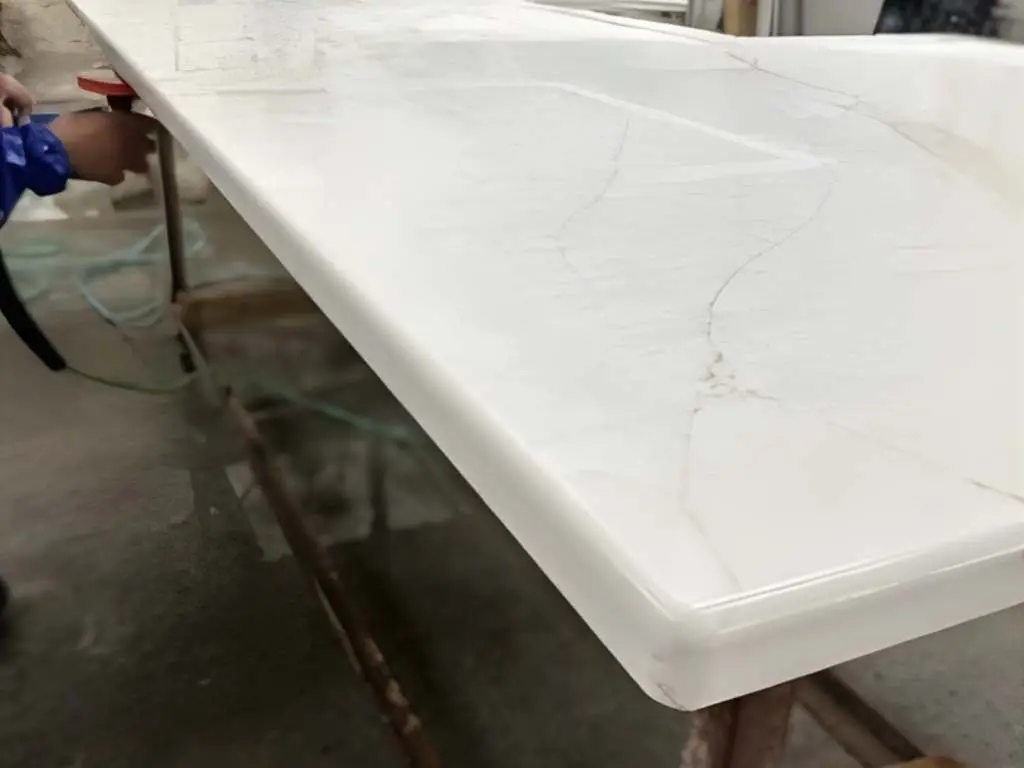
Natural stone has natural imperfections. Pits are small depressions in the surface. Fissures are hairline separations that run below the surface. Neither is a defect — they're characteristics of the material. But you should know they're there before installation, not after.
Run your hand across the surface. If you feel roughness in a specific spot, ask your fabricator whether it's a pit, a fissure, or something that gets addressed during fabrication.
How the Process Works at Granite Plus
Granite Plus serves the 7-county Tampa Bay metro region, and the slab selection process is designed to be straightforward without cutting corners. Here's what the typical flow looks like.
Initial Consultation
Before you select a slab, you'll have a conversation about your project — the space, the material direction, the timeline, and the budget range. This is where the fabricator gets enough information to point you toward slabs that actually fit your project, rather than just showing you everything in the yard.
If you're in the St. Pete area and want a sense of what granite options look like in that market specifically, this overview of granite countertops in St. Pete gives useful context on popular materials and what tends to work well in the local aesthetic.
Slab Selection
You'll select your full slab at one of our preferred stone yards, with guidance from the Granite Plus team. Our St. Petersburg showroom helps you narrow the field first, with 9-foot-tall, countertop-width samples on rolling tray walls. This isn't a self-guided tour. Someone walks you through the options, explains the characteristics of each material, and helps you think through how the slab will work in your specific layout.
Granite Plus carries materials from Cambria, MSI, Pompeii, and Cosentino, including the ÉCLOS line — a surface engineered to perform in demanding environments while maintaining a natural stone look. If you're weighing engineered stone alongside natural options, ÉCLOS is worth seeing in person. The difference between a sample chip and a full slab is significant.
Templating
After slab selection, templating is the next step. A template is a precise digital or physical measurement of your countertop space — every cutout, corner, and edge. It's what allows the fabricator to cut your slab accurately.
If you haven't been through this step before, this guide to countertop templating for Tampa Bay homeowners covers exactly what to expect: what happens during the visit, how long it takes, and what you need to have ready.
Fabrication and Installation
Once the template is complete and the slab is confirmed, fabrication begins. The slab is cut, edges are profiled, cutouts for sinks and cooktops are made, and the surface is finished. Then it's installed.
Timeline from slab selection to installation varies depending on material availability and project complexity. Your fabricator will give you a specific window during the consultation.
Common Mistakes to Avoid During Slab Selection
A few patterns come up repeatedly with homeowners who later wish they'd done something differently.
Approving a slab from a photo. Photos flatten stone. They compress depth, shift color temperature, and miss the variation that runs across a full slab. If you can visit in person, visit in person. If you genuinely can't, ask for multiple photos in different lighting conditions and ask the fabricator to describe the variation across the full surface.
Choosing natural stone based on the sample chip alone. The chip tells you the material family and general color range. It doesn't tell you what your specific slab looks like. Always confirm on the actual slab. Samples are great for quartz, but require full-slab inspection for all natural stones.
Ignoring the lighting in the stone yard. Some stone yards use overhead warehouse lighting, which is different from the natural light and warm kitchen lighting you'll have at home. Hold a phone flashlight at an angle across the surface — it reveals texture and variation that flat overhead light hides.
Not thinking about seams. If your project requires more than one slab, seams are inevitable. A good fabricator will show you where seams will fall and how they'll be matched. Ask about this during selection, not after fabrication. There a trade-offs between price and esthetics. At Granite-Plus we bias toward beauty in our estimates. We will recommend an extra slab if that's what it takes to create the greatest esthetic impact. Long full-height backsplashes, 90 degree turns, and oversized islands are where seam quality and pattern continuity matter most.
Tampa Bay Specifics Worth Knowing
The Tampa Bay metro has a few characteristics that influence material choices in ways that don't apply everywhere.
Humidity is real here. Coastal air and high ambient moisture mean porous natural stones need to be sealed properly and resealed on a regular schedule. Granite is relatively forgiving: it is dense enough that a quality penetrating stone sealer applied at installation and refreshed every year or two keeps it protected. For marble, ask which quality penetrating sealer will be used and follow its product-specific care instructions. Modern sealers can provide long-lasting stain resistance, so a blanket annual resealing schedule is not a useful guide. Wipe spills promptly and use a neutral stone cleaner. Sealing improves stain resistance; it does not prevent acid etching.
The coastal aesthetic also shapes what looks right. Lighter stones with soft movement, cool grays, and warm whites tend to fit the visual language of Tampa Bay homes better than the dark, dramatic stones that trend in colder markets. That's not a rule — it's an observation from working in this market specifically.
If your project includes a bathroom renovation alongside the kitchen countertop work, coordinating both at once often makes scheduling and material matching easier. A full-service fabricator can help manage that across rooms. And don't forget about our square foot program colors. When shifting project dollars into high-end, custom, full-slab design elements, you can recover the extra costs by completing smaller spaces by the square foot. Cost shifting from secondary spaces into primary spaces is a common technique for value engineering a project.
FAQs
Do I have to select my slab in person, or can I approve it remotely? In-person selection is strongly recommended for natural stone. Photos don't capture the full variation, depth, or surface texture of a slab. Engineered stone is more consistent and can sometimes be approved remotely, but even then, seeing it at full scale is worth the trip.
How long does a slab selection appointment take? Most appointments run between 45 minutes and 90 minutes, depending on how many options you're considering and how much guidance you need. Coming prepared with photos of your space and a clear sense of your material direction shortens the process.
What if I can't find a slab I like in the current inventory? Inventory at stone yards turns over regularly. If nothing in stock fits your project, your fabricator can tell you what's incoming or help you source a specific material. It's worth waiting for the right slab rather than settling for one that's almost right.
How many slabs will I need for a typical kitchen? Most kitchen projects use one to two slabs, depending on square footage and layout. An island plus perimeter countertops in a larger kitchen may require two slabs, which raises the question of how well they match. Your fabricator will calculate this during the initial consultation.
What's the difference between granite and quartzite in person? Granite tends to have a granular, speckled appearance with less dramatic veining. Quartzite often looks more like marble — flowing veins, more luminous surface. In person, the difference is obvious. On a small sample chip, they can look similar. If you're unsure which you're looking at, ask.
Does Granite Plus serve all seven counties in the Tampa Bay metro? Yes. Granite Plus fabricates and installs countertops across the full 7-county Tampa Bay metro region, including Hillsborough, Pinellas, Pasco, Hernando, Polk, Manatee, and Sarasota counties.
What happens if the slab gets damaged during fabrication? Reputable fabricators stand behind their work through fabrication and installation. Ask about this policy during your consultation — specifically what happens if there's a crack or damage during cutting, and whether a replacement slab from the same lot is available.
Starting Your Project
Picking a countertop slab is a decision you'll see every day. Getting it right means seeing the actual material in person, understanding what you're looking at, and working with a fabricator who walks you through the process rather than just handing you a catalog.
If you're planning a kitchen or bathroom project in the Tampa Bay metro, the process at Granite Plus starts with a conversation about your space. Slab selection, templating, fabrication, and installation follow a clear sequence from there — with a team that knows this market. You can learn more and start that conversation at granite-plus.net.